
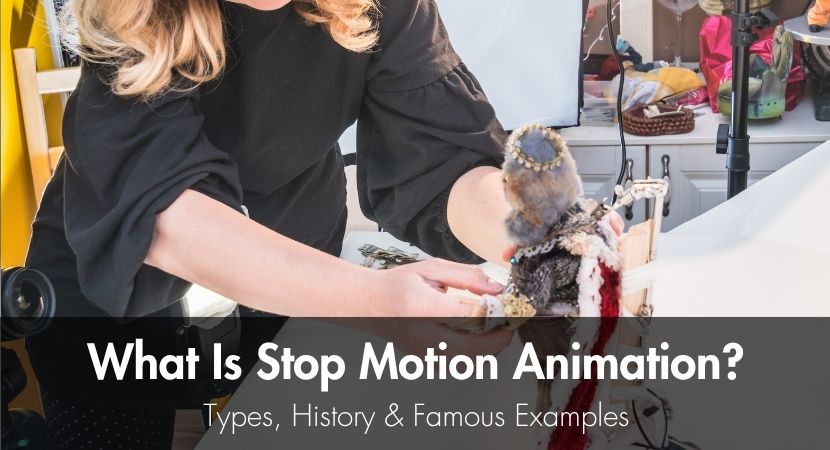
Stop motion is an animation technique in which physical objects are photographed one frame at a time and shifted in tiny increments between shots. Played back in sequence, those frames create the illusion of smooth movement. The method dates back to 1898 and is still actively used in film, TV, and advertising today.
In this guide, we’ll talk about what stop motion is, different stop motion types, its rich history, stop motion in movies, how it’s made, and why we still see this age-old technique even in this new era dominated by CGI and AI tools.
What Is Stop Motion Animation?
Stop frame animation, as the technique is also called, works on a simple principle: the camera never records movement at all. Every frame is a still photograph, and the motion exists only in the gap between one shot and the next.
A subject can be almost anything: clay characters, puppets, paper cut-outs, everyday objects, and even live actors.
But it's not as easy as it sounds. Professional stop motion typically plays back at 24 frames per second, which means every second of finished film is built from two dozen separate photographs. That arithmetic is what makes the technique so demanding, and it is covered in detail further below.
Types of Stop Motion Animation
There are different stop motion techniques, and each method is distinguished by its materials, production process, visual style, and overall character.
Here are the most common types:
Claymation
This is where characters are molded from clay or plasticine and are reshaped for each frame to display intended movement. This technique was used in Wallace & Gromit, Chicken Run (2000), and in Celebrity Deathmatch, a claymation TV series that launched in 1998.
Puppet Animation
Puppet animation uses physical models of characters that are manipulated frame by frame, much like clay animation. However, unlike clay figures, puppets have internal armatures or skeletons that allow them to hold their poses without being reshaped for every frame. This provides animators with more precise control over body movements, including the limbs, hands, and facial expressions, often through interchangeable face plates or facial components. This technique was used in Coraline (2009) by the American studio Laika, which has since become the leading name in feature puppet animation. More recent stop motion examples include Missing Link (2019) and Guillermo del Toro's Pinocchio (2022), the latter of which won the Academy Award for Best Animated Feature at the 95th Academy Awards in 2023.
See it in action: This behind-the-scenes look from LAIKA shows how the puppets, sets, and practical animation techniques behind Coraline were created:
Cutout Animation
Cutout animation uses paper, cardboard, or other flat materials to create characters and objects that are moved and photographed frame by frame, typically from an overhead camera. Unlike traditional hand-drawn animation, where each frame is drawn from scratch, cutout animation requires the character's individual parts, such as the head, torso, arms, legs, and facial features, to be created only once. These pieces are then repositioned or replaced between frames to create the illusion of movement. This technique was famously used in the original South Park pilot, "Cartman Gets an Anal Probe" (1997), which Trey Parker and Matt Stone animated with real construction paper over roughly three months. It remains the only episode of the series made almost entirely without computers; from the following episode onward, the show switched to digital tools that replicated the same paper-cutout look.
Object Animation
This is the use of everyday items to create animation. It does not involve creating anything from scratch. The earliest known film that used this method is The Humpty Dumpty Circus (1898).
A subset of this method is LEGO animation or the use of the popular plastic construction toys by the Danish company The LEGO Group. This has become one of the most common methods for beginner animators and an entry point for hobbyists.
Pixilation and Silhouette Animation
This is the most unusual of the stop motion techniques, because it uses live human actors as frame-by-frame subjects. The goal of this technique is to create a surreal and, when executed well, often comedic effect. For a deep dive into this technique, see our guide to pixilation animation.
Another type of stop motion is silhouette animation, which uses flat, jointed cutout figures placed between a light source and the camera to create shadow-like silhouettes. This technique was pioneered by German filmmaker Lotte Reiniger in the 1920s and is known for its distinctive, high-contrast visual style.
Stop Motion in Film: Key Milestones and Famous Examples
Stop motion is one of the oldest methods of animation, dating back to the late 1890s. The first early experimental use of the technique was in The Humpty Dumpty Circus in 1898 by J. Stuart Blackton and Albert E. Smith. In the production, Smith used his daughter’s toys as subjects. Today, this method is known as object animation, where everyday items are used to create a stop motion film.
One noteworthy stop motion experiment before the medium reached its peak was Ladislas Starevich's insect animations in the 1910s, in which real insect specimens were used as characters. Although they appeared to be actual insects, the specimens were fitted with wire armatures, effectively turning them into articulated puppets. As a result, the technique is considered a form of puppet animation rather than a separate type of stop motion.
The golden age of special effects began in the early 1900s, with stop motion becoming one of the defining techniques of the era. It brought fantastical creatures to life in landmark films such as Willis O'Brien's The Lost World (1925) and King Kong (1933). Decades later, Ray Harryhausen continued to push the boundaries of stop motion with films such as Clash of the Titans (1981). Harryhausen pioneered Dynamation, a compositing technique introduced in The 7th Voyage of Sinbad (1958) that allowed animated creatures to interact convincingly with live actors and environments.
In the late 1900s came the TV and claymation era. Stop motion reached mainstream American television through the Rankin/Bass holiday specials of the 1960s and 1970s, and it produced one of the most-played music videos in MTV history: Peter Gabriel's Sledgehammer (1986), animated by Aardman. This was also when the British franchise Wallace & Gromit (claymation series) conquered global television with its family-friendly comedic vibe featuring a middle-aged inventor (Wallace) and his enthusiastic beagle (Gromit).
Entering the modern renaissance of animation in film, we have The Nightmare Before Christmas (1993), directed by Henry Selick, created with 227 puppets and over three years of production time. There was also Wes Anderson’s Fantastic Mr. Fox (2009) and Isle of Dogs (2018).
During this time, stop motion was no longer the dominant technique in filmmaking as CGI became the preferred choice for visual effects and animation. However, rather than disappearing, the medium adapted. Studios adopted digital cameras, computer-controlled motion control rigs, 3D printing, and digital compositing to make productions more efficient while preserving the distinctive look that only stop motion can achieve.
In the 2020s and until today, stop motion continues to be widely used in commercials and advertising, while also appearing in acclaimed feature films such as Guillermo del Toro's Pinocchio (2022), Memoir of a Snail (2024), and Wallace & Gromit: Vengeance Most Fowl (2024).
Although it is no longer the dominant animation technique, many filmmakers deliberately choose stop motion for its handcrafted authenticity, tactile textures, and distinctive visual charm. In an era where CGI and digital visual effects dominate filmmaking, stop motion offers a unique artistic style that stands out by celebrating the imperfections and craftsmanship of physical animation.
How Does Stop Motion Animation Work?
While stop motion animation can simply be described as taking frame-by-frame photographs of a physical subject and combining them into an animation, the process involves far more behind-the-scenes work than most people realize.
Before any scenes are captured, stop motion goes through a pre-production phase, just like live-action and other forms of animation. This stage includes: storyboarding, character and set design, armature construction, and meticulous shot planning.
Depending on the complexity of the project, pre-production alone can take anywhere from several months to years.
Equipment and Setup
Stop motion requires very similar equipment and setup to on-site filming, with the addition of software for animation itself. The basics: camera and lighting.
A DSLR or mirrorless camera mounted on a sturdy tripod is ideal for capturing stable shots of subjects without an inch of change to framing, which is very important. Lighting should also be very stable across shots since the most subtle of changes to lighting can cause visible flickering in the final sequence.
Fun fact: the first stop motion feature shot with a digital still camera, the Canon EOS-1D Mark II, was Corpse Bride in 2005.
Finally, frame-grabbing software like Dragonframe is essential for animators to preview their work in real time.
The Frame-by-Frame Process
The frame-by-frame capture process in stop motion follows a repetitive cycle. The subject or subjects are carefully positioned, a frame is captured, and then they are slightly repositioned before the next frame is taken. This process is repeated hundreds or even thousands of times until the animation is complete. At 24 frames per second (FPS), one minute of animation requires 1,440 individual frames. When animated "on twos," where each image is held for two frames, that number is reduced to 720 unique photographs.
To put this into perspective, a professional stop motion animator typically completes only a few seconds of usable footage per week, not per day.
Laika's Kubo and the Two Strings (2016) illustrates the scale of the problem. The film took five years from start to finish and ran as many as 66 shooting stages at once, the most the studio had ever operated. Even with that setup, each animator averaged roughly three seconds of usable footage per week, and on the most complex sequences that dropped to about two. Laika's general studio benchmark is around 4.3 seconds per animator per week, so Kubo came in below even that. Scale, in other words, does not make stop motion fast: a feature-length production stays labor-intensive no matter how large the crew.
Behind the scenes: LAIKA's look at the Garden of Eyes sequence gives a good sense of just how much physical craftsmanship can go into a single stop motion environment.
Post-Production and Compositing
This is the stage where everything comes together and gets polished up to become worthy of being viewed by an audience. This is where rigs are removed from captured scenes, backgrounds are composited, frames are color graded, and this is also where CGI is applied, where needed.
Rendering is also part of post-production, converting digital assets and visual effects into the final frames that blend seamlessly with the photographed stop motion footage.
Rendering and compositing can also become resource-intensive in modern stop motion, especially when shots include rig removal, digital backgrounds, color grading, or CGI effects. For feature-length productions, these post-production steps can add significant processing time after the physical animation is complete. Render farms like RebusFarm allow studios to scale rendering for stop motion post-production work, reducing rendering times by distributing computing work to hundreds and even thousands of nodes if needed.
From storyboard to screen: This behind the scenes look at Wallace & Gromit: Vengeance Most Fowl shows how Aardman's artists turn physical models and sets into finished stop motion animation.
Stop Motion vs CGI: Why Do Filmmakers Still Choose Stop Motion?
CGI is the process of creating images with computer software, while stop motion makes use of physical objects to create animation.
Although CGI dominates the modern film industry because of its flexibility and efficiency, stop motion continues to be used by filmmakers who value its handcrafted aesthetic, tactile realism, and distinctive visual charm.
But this is not the only reason stop motion continues to thrive. While it naturally evokes a sense of nostalgia, it also allows filmmakers to present audiences with elements that are physically real. The characters, props, and sets exist as tangible objects, allowing the camera to capture genuine textures, shadows, lighting, and surface imperfections. This physical authenticity gives stop motion a distinctive quality that is difficult to replicate digitally.
Both are great techniques, and they’re not meant to contradict each other. In fact, many modern stop motion films use them together. Laika and Aardman use CGI for backgrounds, effects and rig removal while using stop motion for their characters and key animations.
For a full explanation of CGI and how it relates to other terms, see our guide to CG and CGI meaning.
Getting Started with Stop Motion Animation
Stop motion has a low barrier to entry: the concept is simple and easy to learn, and the basic setup is cheap, even though professional productions are highly labor-intensive and expensive. With a smartphone, a tripod, and household objects, you can shoot your first sequence today. You also do not need a sophisticated stop motion animation program nor high-level computer skills. Beginner-friendly apps like Stop Motion Studio exist alongside professional tools like Dragonframe.
However, there’s a progression that beginners should follow. It’s best if you start with simple object animation first to learn the proper setup, stop motion animation techniques, what works, and what doesn’t. Then, move to more complex setups with clay or wire-armature figures, which will need a higher level of artistry.
Like any other skill, it’s all about patience and consistency. The good thing about learning stop motion is that you can really focus on mastering the craft and not think about budget.
Two important concepts you should learn right from the start are timing and spacing fundamentals, which apply to all animation.
FAQ
What does stop motion mean?
Stop motion is an animation technique that uses physical objects, such as clay figures, puppets, paper cutouts, or even live actors, which are photographed frame by frame to create the illusion of movement.
How many frames does one minute of stop motion animation need?
The standard playback rate for animation is often 24 frames per second, which equals 1,440 frames per minute. However, many stop motion projects are shot “on twos,” meaning the animation still plays at 24 fps, but each pose is held for two frames. This reduces the workload to about 12 unique frames per second, or roughly 720 unique photographs per minute, while still keeping the motion readable.
What is the difference between stop motion and claymation?
Stop motion is the method of creating animation in which physical objects are moved and photographed frame by frame. Claymation is one type of stop motion that uses clay or plasticine figures as the animated subjects.
Is stop motion animation still used in professional films?
Yes, stop motion is still a widely used technique in professional films. Guillermo del Toro's Pinocchio (2022) used stop motion as its primary animation method and won the Academy Award for Best Animated Feature. Wallace & Gromit: Vengeance Most Fowl (2024) showed that major studios continue to invest in the technique for feature-length work.
Can stop motion and CGI be combined in one project?
Yes, stop motion and CGI can be combined in one project. Many modern productions use physical stop motion for characters and sets, then add CGI for rig removal, backgrounds, effects, cleanup, or compositing.

About the author
Nicole Holt is an experienced 3D enthusiast with a career in marketing and content writing. Thanks to this unique combination, she is able to showcase the technical intricacies of 3D art and rendering while also making the subject accessible to a wide audience. When she's not immersed in the digital world, Nicole can be found in the great outdoors, most likely with her beloved dog, Sammy.